Last updated: July 2026
The best MeetingPackage alternatives for hotel and venue M&E teams
If you're weighing up MeetingPackage for hotel or venue meetings and events (M&E) sales, this is the shortlist that saves you time researching. Ten alternatives, what each one is actually built to do, what it costs where that's public, and who each one suits.

Why teams look for a MeetingPackage alternative
Meeting, event and convention teams are drowning in manual work: parsing enquiry emails, chasing the detail the planner left out, pricing space and bedrooms by hand, building a proposal, then following up. Hotels and venues that respond within a few hours convert group enquiries at roughly twice the rate of next-day responders, and by 48 hours the chance to win the business is close to zero.
So the real question underneath “what else is out there” is how much of that work each platform takes off your team, and how much it just organises for someone else to do. That is what this list compares.
What MeetingPackage does
MeetingPackage was founded in 2014 in Espoo, Finland, after its CEO spent hours trying to book a meeting room and found venues were losing deals they never even saw. The product it sells today is a central reservation system (CRS) for groups, meetings and events, made up of a booking engine, an eProposal, a channel manager, global lead passing and an AI Suite of five agents. MeetingPackage markets itself as “the first AI-native CRS platform” and an “AI-enhanced operating system for Groups, Meetings & Events”, sells to hotel groups across Europe and North America, and names Sonesta and Strawberry among its customers.
What to look for in a MeetingPackage alternative
Most shortlists in this category compare feature lists, which is how teams end up with software that demos well and changes nothing. Seven questions separate the products faster:
- Does it capture enquiries from every channel, including the phone? Email, your own website form, distribution channels, and calls – or only some of them.
- Does it qualify each enquiry and chase the missing detail automatically? Most enquiries arrive incomplete. Someone has to go back and ask.
- Can it build a priced quote across space, bedrooms, F&B and AV without a person? This is where most automation stops, because pricing has traditionally been a conversation.
- Does the proposal update in place, and can the planner sign it there? Or does every revision become another PDF in an inbox, and the contract a print-sign-scan chase.
- Does it fill the room block after the contract is signed? This is where the hours go once the deal is won: rooming lists arriving as spreadsheets, every revision compared line by line against the last, then typed into the PMS by hand.
- Does it read from your sales and catering (S&C) system, property management system (PMS), revenue management system (RMS) and CRM, or only write to them? Reading availability and rate rules is what makes an automated quote possible at all.
- Is the AI doing the work, or assisting a person who is still doing the work? Nearly every product in this category now markets AI. Far fewer of them remove an activity rather than adding a screen.
Take those seven into any demo below and the differences stop being subtle.
The 10 best MeetingPackage alternatives
1 of 10
hivr.ai – the AI Sales Engine for meetings, groups and events
Origin, scope and first response
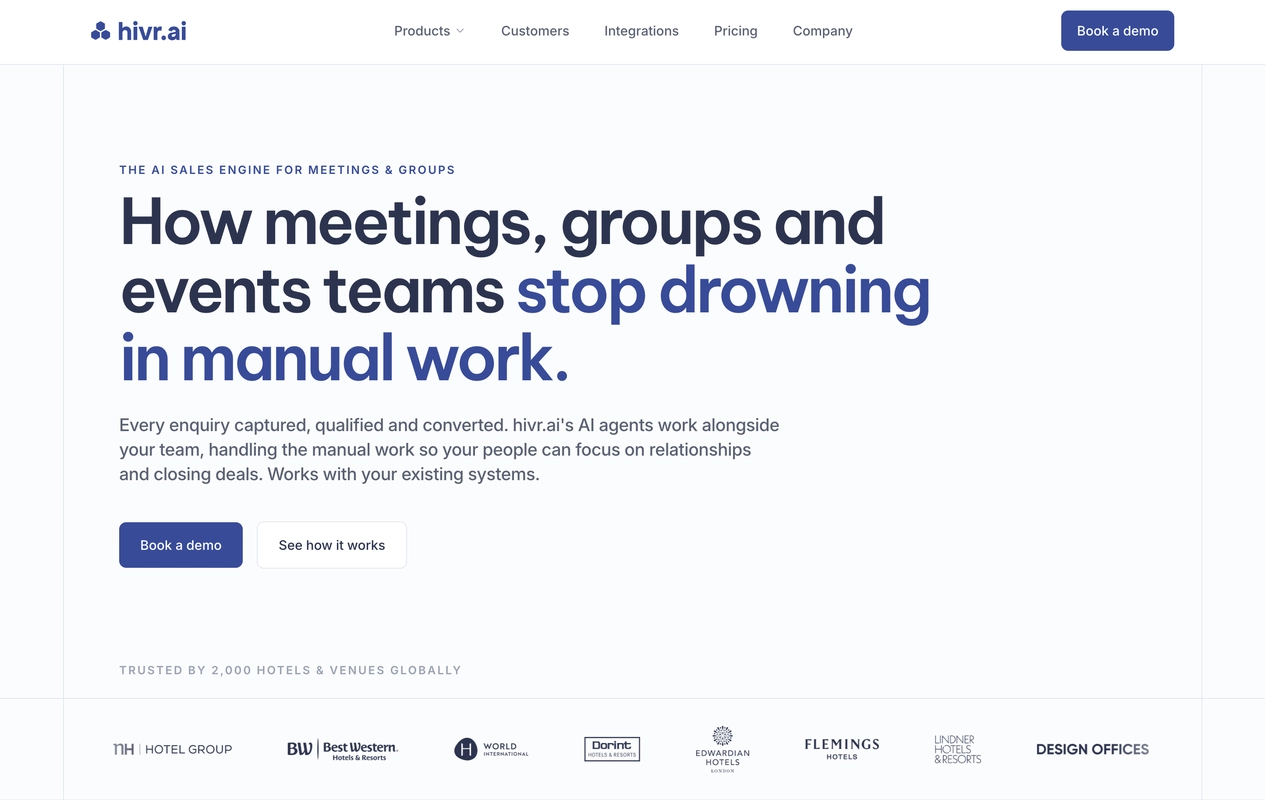
hivr.ai is the AI Sales Engine for meetings, groups and events, founded by Felix Undeutsch after fifteen years in M&E technology that included leading meetings and groups innovation at Expedia. It is the only solution on the market built AI-first from the ground up: AI agents that can do the work end to end, rather than another tool someone has to learn.
The agents read each enquiry the moment it lands, whatever channel it arrived on – email, the venue's own website, a distribution channel such as Cvent, or the phone, where a voice agent can answer around the clock in 50+ languages and qualify the caller while they are still on the line. Nothing sits unread because it landed somewhere nobody was watching. From there the agents chase whatever detail the planner left out and build the quote across space, bedrooms, F&B and AV, priced against rules, restrictions and conditions the revenue team sets up front rather than negotiated enquiry by enquiry.
Proposal, signature and room block
The proposal that comes out is a live page rather than a PDF attachment, with price, space and terms updating in place, so the planner is never hunting for the latest version. They sign on that page, and it is binding. After the contract the agents fill the room block however the names arrive, reconciling each revised list into the property management system (PMS).
Alongside that sits a direct booking engine covering all four inventory types at once – space, bedrooms, F&B and AV – for anything from a single boardroom on a Tuesday to a three-day conference across four breakout rooms, either confirmed instantly or passed to the sales team as a request. Planners set it up by describing the event to an AI agent in plain language instead of working through a form, and since roughly 70% of requests are for fewer than 30 people, the small ones largely book themselves.
Control, integrations and scale
How much of this runs without a person is a setting rather than a fixed model, which is the part that tends to matter most in practice. Hotels define which steps the agents own and which stay with the team, and can move that line by season, enquiry type or property. Design Offices wrote its own ruleset – instant automated booking for short-lead single-room meetings, complex events staying with the team throughout – and reported 250 hours a year saved and $172K in added revenue.
Underneath, the agents read meeting-room availability from the sales and catering (S&C) system, bedroom availability from the PMS and the rate rules revenue management maintains, then write the enquiry, the proposal and the confirmed booking back, matched to the right account, across 100+ integrations, so nothing already in place has to come out. In 2025 it processed 100,000+ RFPs and $2.5B+ in group business across 2,000+ hotels and venues, in 160+ languages. Amadeus Ventures, the corporate venture arm of Amadeus, is an investor – worth knowing alongside the Amadeus entry further down this list.
Best for
Hotels and venues that want the manual work out of M&E sales – capture, qualification, quoting, proposals, signature, the room block and direct booking – with the team deciding how much of it the agents own. On the technology itself it leads the ten: it is the only solution on the market built AI-first from the ground up.
See the AI leader at work
From international groups to independents, 2,000+ hotels and venues run their meetings and groups business on hivr.ai.
Book a demo2 of 10
Cvent – planner marketplace, instant booking and room blocks
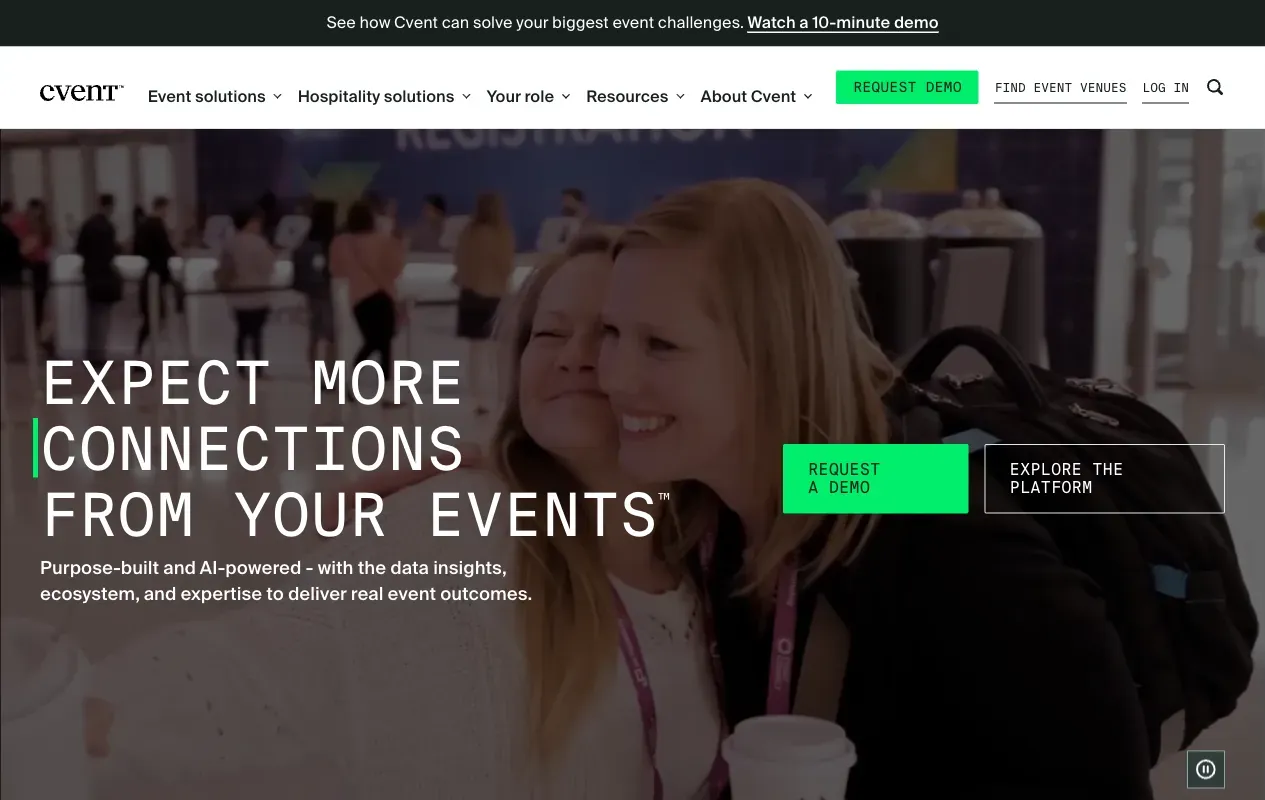
Cvent was founded in 1999 in Tysons, Virginia, as event management and registration software for corporate and institutional clients, and its supplier side is what Cvent describes as the largest marketplace connecting planners to venues. For hotels and venues it sells an “all-in-one platform to attract, convert, and manage group, meeting, and corporate travel business”, organised into Attract, Convert, Manage and Improve. Two modules matter most here: Instant Book, which lets planners book simpler meetings and guest rooms in real time without an RFP, and Passkey, which automates room blocks and rooming lists. Cvent states it takes no commission on RFPs sent or awarded and is not involved in contracts or negotiations, so what arrives at the hotel is demand, and the answering is yours. hivr.ai captures enquiries arriving through Cvent as one of its channels.
Best for
Hotels whose priority is exposure to the planner network Cvent describes as the market's largest, and who are staffed to answer every RFP it sends them.
3 of 10
Tripleseat – event CRM for restaurants and unique venues
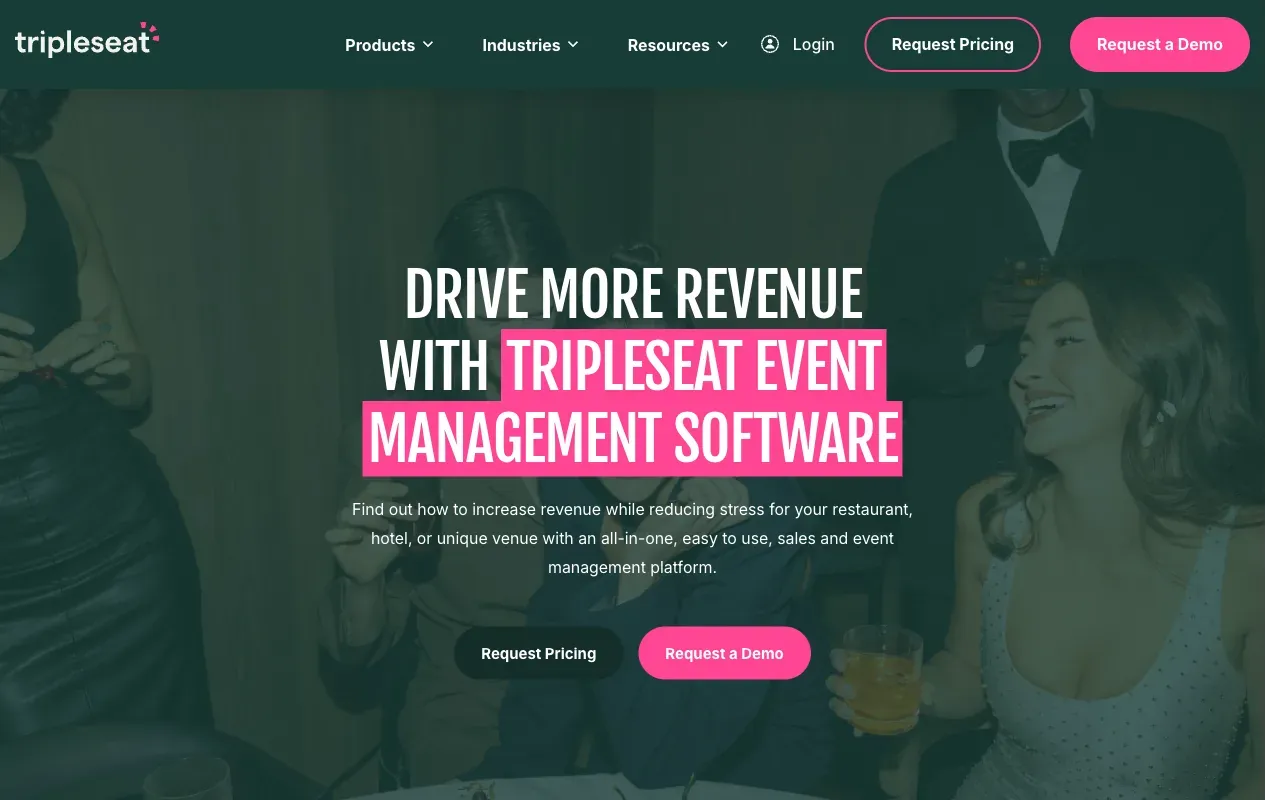
Tripleseat was founded in 2008 in Concord, Massachusetts, explicitly “to replace the spreadsheets, emails, and paper contracts many venues relied on to manage events”, and reports 63,000 restaurant and hotel event and sales managers using it. It sells a core event-and-booking CRM alongside Tripleseat for Hotels, Direct Book for self-service reservations, floor plans, tickets, a venue marketplace, insights and payments, with its AI capabilities marketed as Tripleseat Intelligence. Its centre of gravity is the restaurant, private-dining and unique-venue market, where the event itself is what is being sold, and it has extended into hotels from there. Pricing is quote-only.
Best for
Restaurants, private-dining rooms and unique venues where the event is the product, rather than hotels selling meeting space alongside bedrooms and a contracted room block.
4 of 10
Event Temple – hotel sales-and-catering CRM with published pricing
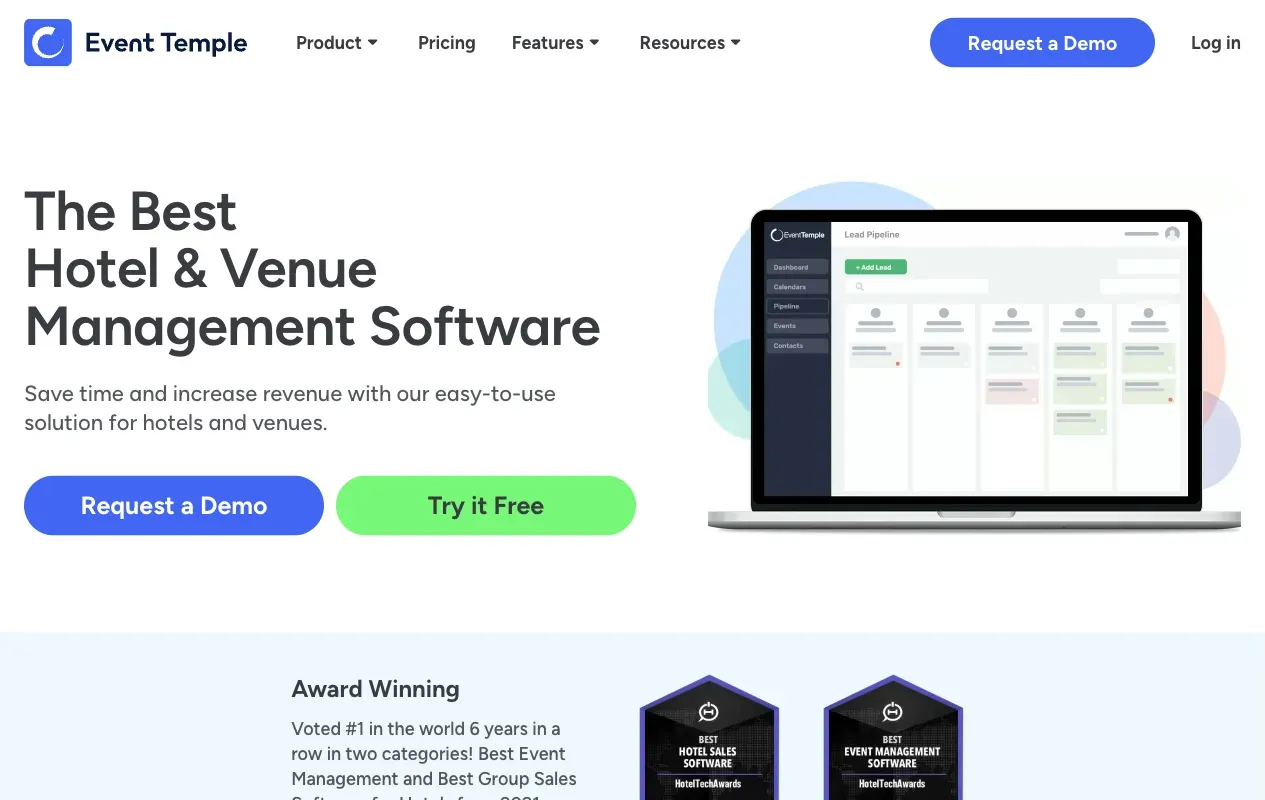
Event Temple was founded in Vancouver in the mid-2010s and works exclusively with hotels and venues. It sells a sales-and-catering CRM: pipeline and sales CRM, hotel group sales, events and catering management, e-proposals and documents, invoicing and payments, workflow automation, chain management, PMS integration, and an AI Sales Suite covering AI Email to Lead, a smart proposal builder and a lead inbox. Its CEO describes the goal as hotel sales teams going “from lead to proposal in seconds”. It is one of the few vendors in this category that publishes a starting price – from $249 per month on annual billing, as of July 2026 – it operates in around 40 countries, and it holds 4.8 out of 5 on HotelTechReport. hivr.ai and Event Temple integrate: the enquiry-to-signature work runs in hivr.ai and flows straight into the CRM.
Best for
Hotel sales teams that want one dedicated sales-and-catering CRM to live in, priced openly, and who have the people to work the pipeline it organises. Read the full Event Temple head-to-head comparison.
5 of 10
iVvy – end-to-end venue and event management suite
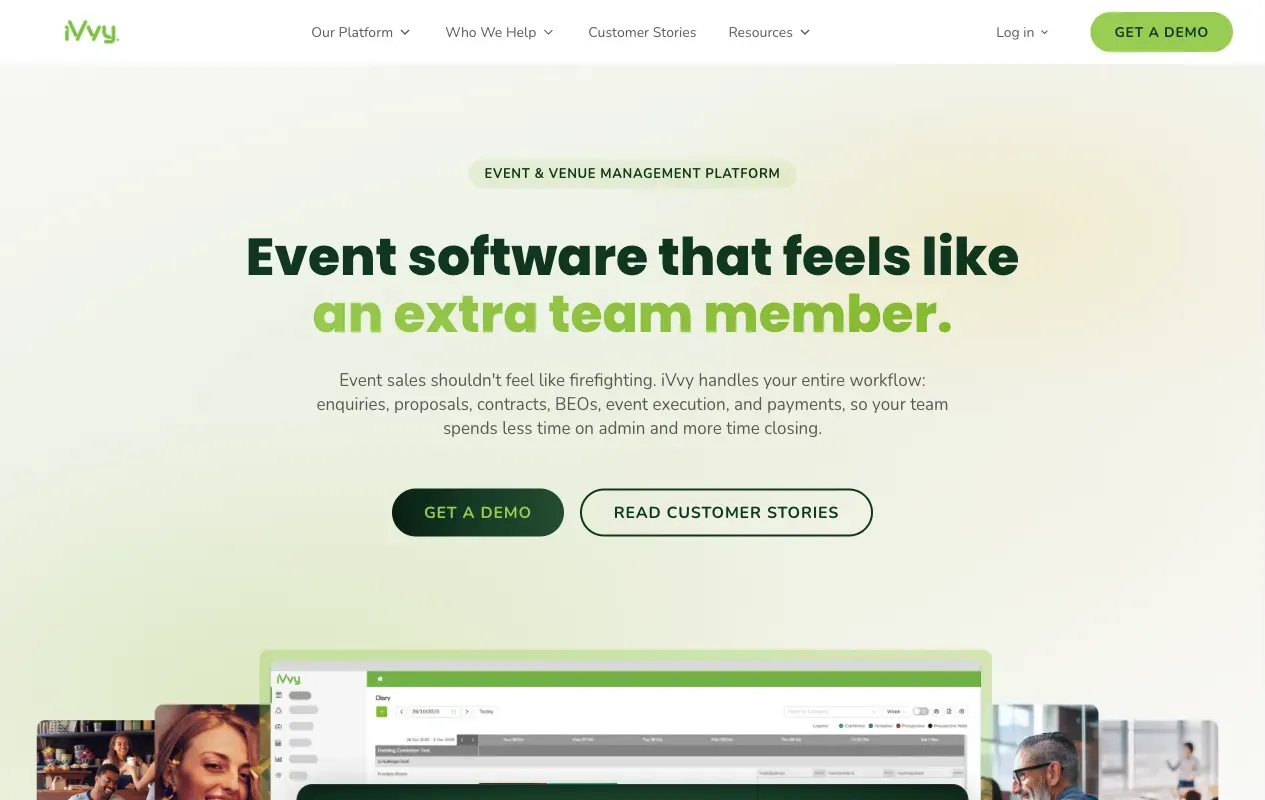
iVvy was founded in 2009 on the Gold Coast, Australia, to help venues respond to enquiries faster and reduce manual work, and now runs across APAC, the UK and Europe, and North America. It sells end-to-end venue and event management: CRM, function diary, proposals, e-signed contracts, banquet event orders, invoicing, event ticketing, iVvyPay for payments, iVvyAI with its Instant Proposal, and 55+ integrations into PMS, accounting, payment and CRM systems. Its customer list includes Accor Hotels, TFE Hotels and Tottenham Hotspur. Its breadth is the point: the function diary and the banquet event order sit in the same system as the enquiry that started them. The two companies are partners: iVvy is hivr.ai's exclusive distribution partner in APAC, and several iVvy products – iVvyAI, Email Agent, Lead Qualification Agent, Data Entry Agent and Instant Proposal – run on hivr.ai underneath.
Best for
Event venues that need one system spanning the function diary, banquet orders, ticketing and payments, where running the event matters as much as winning it. Read the full iVvy head-to-head comparison.
6 of 10
VenueSuite – commission-free direct booking for European venues
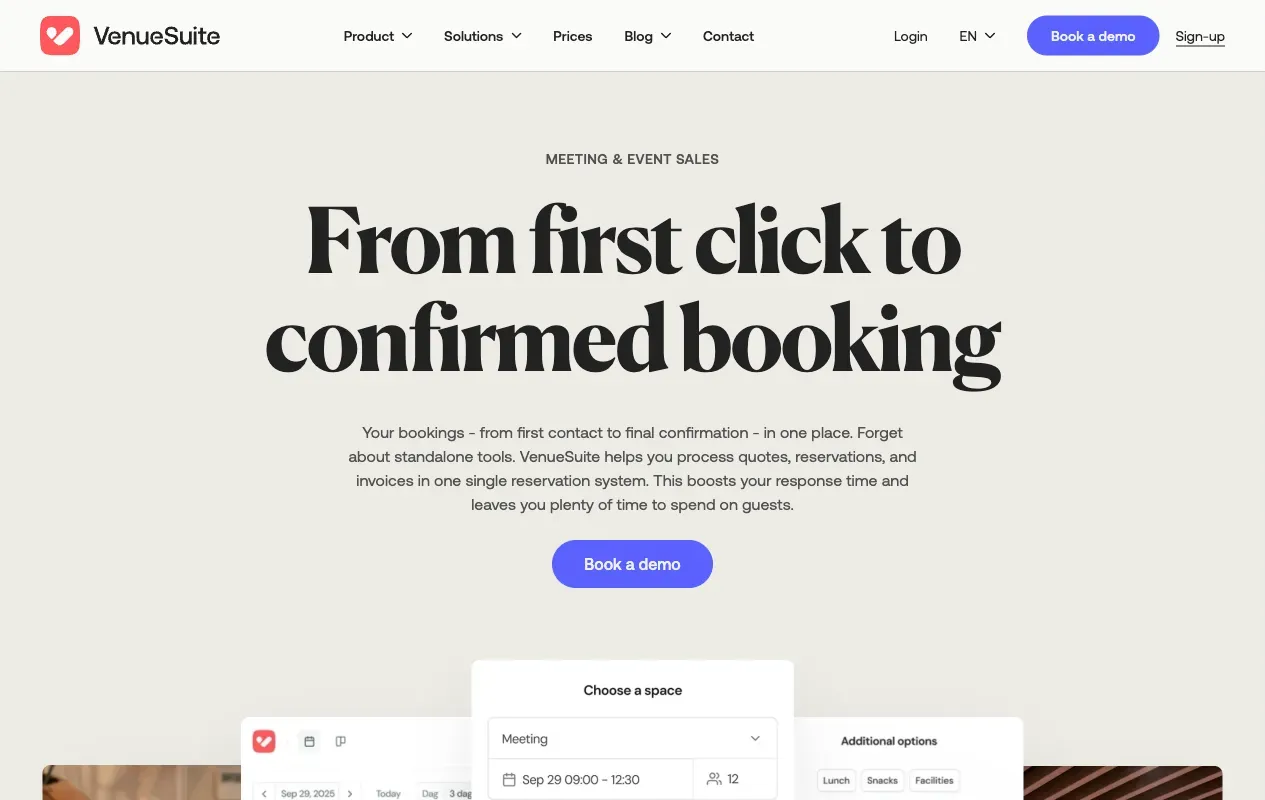
VenueSuite is a Dutch platform, based in Nieuwegein, built around commission-free direct bookings on a venue's own website. It sells a booking engine, an e-Proposal the planner can sign and pay on, a reservation and calendar system, CRM functions, dynamic pricing, invoicing, and integrations into accounting, PMS and payment providers. Of the vendors here it is the most functionally similar to MeetingPackage's original product, and the most transparent commercially: pricing is published openly at €0, €79 and €176 per month excluding VAT, with one-off setup fees of €195 and €295 on the two paid tiers and an enterprise tier on request, as of July 2026, and its own site states that “you do not pay commission for your bookings. Since guests book directly through your website, you retain all the revenue.” It names Ambassade Hotel Amsterdam, Aristo Meeting Centre and Green Village as customers, and holds 4.4 out of 5 across 38 HotelTechReport reviews, mostly European.
Best for
European meeting venues that want commission-free direct bookings from their own website at a published monthly price, and whose enquiry volume one person can still work through by hand.
7 of 10
MICEdesk – AI automation layer for DACH hotel groups
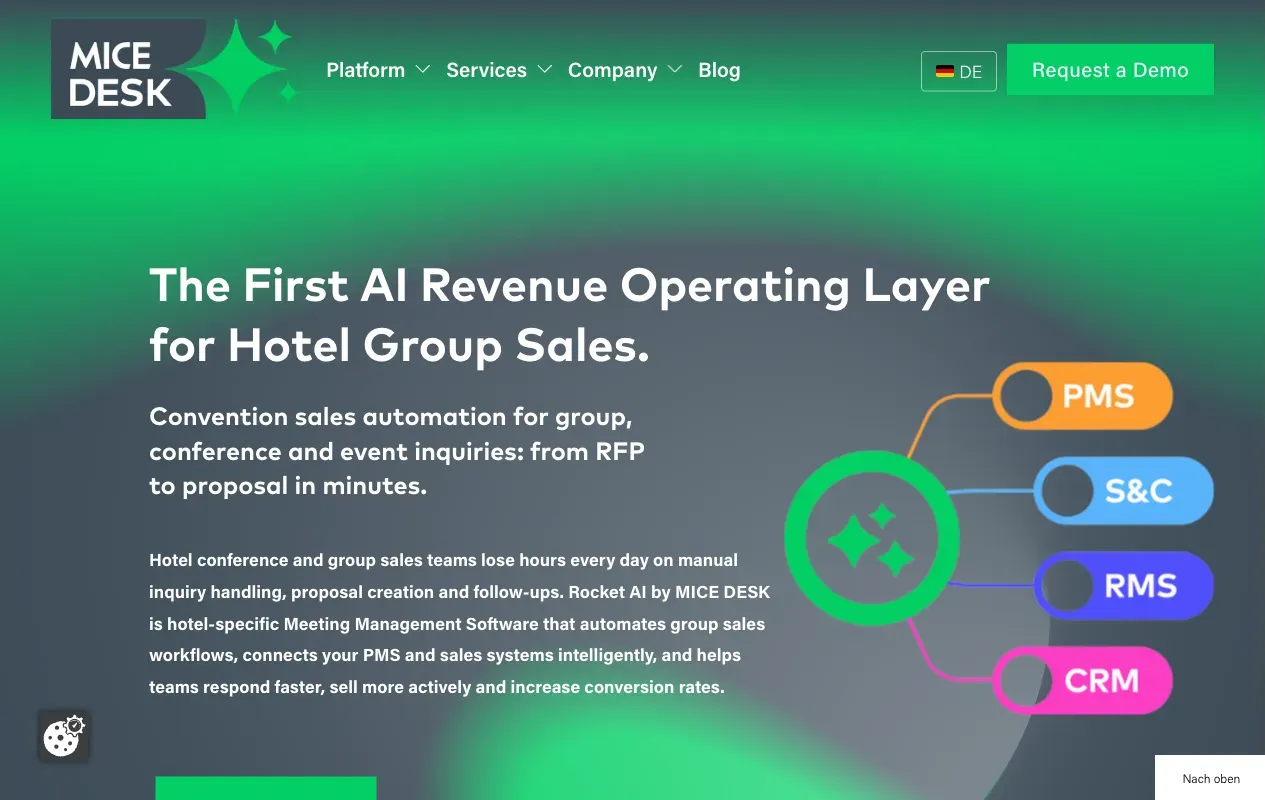
MICEdesk is built by myhotel.team GmbH in Leipzig, Germany, and markets its software as Rocket, sold in Core, Sales & Catering and Enterprise tiers alongside MICEdesk Crew, a hybrid of software and human experts. Rocket processes inbound hotel group, conference and event enquiries: it analyses the request, checks availability and pricing across the PMS, sales-and-catering, revenue-management and CRM systems, and generates a proposal for review. Its tagline is “The First AI Revenue Operating Layer for Hotel Group Sales”, and it describes large language models, large action models, human-in-the-loop review and RPA for connecting to older systems. Its own product page is explicit about where it sits: Rocket “does not replace existing PMS, CRM, RMS, or Sales & Catering systems.” Pricing is quote-only and depends on the tier.
Best for
Hotel groups in the German-speaking market that want an automation layer sitting over the property management, CRM and sales-and-catering systems they already run. Read the full MICEdesk head-to-head comparison.
8 of 10
Amadeus – Delphi for sales and catering, MeetingBroker for RFP intake
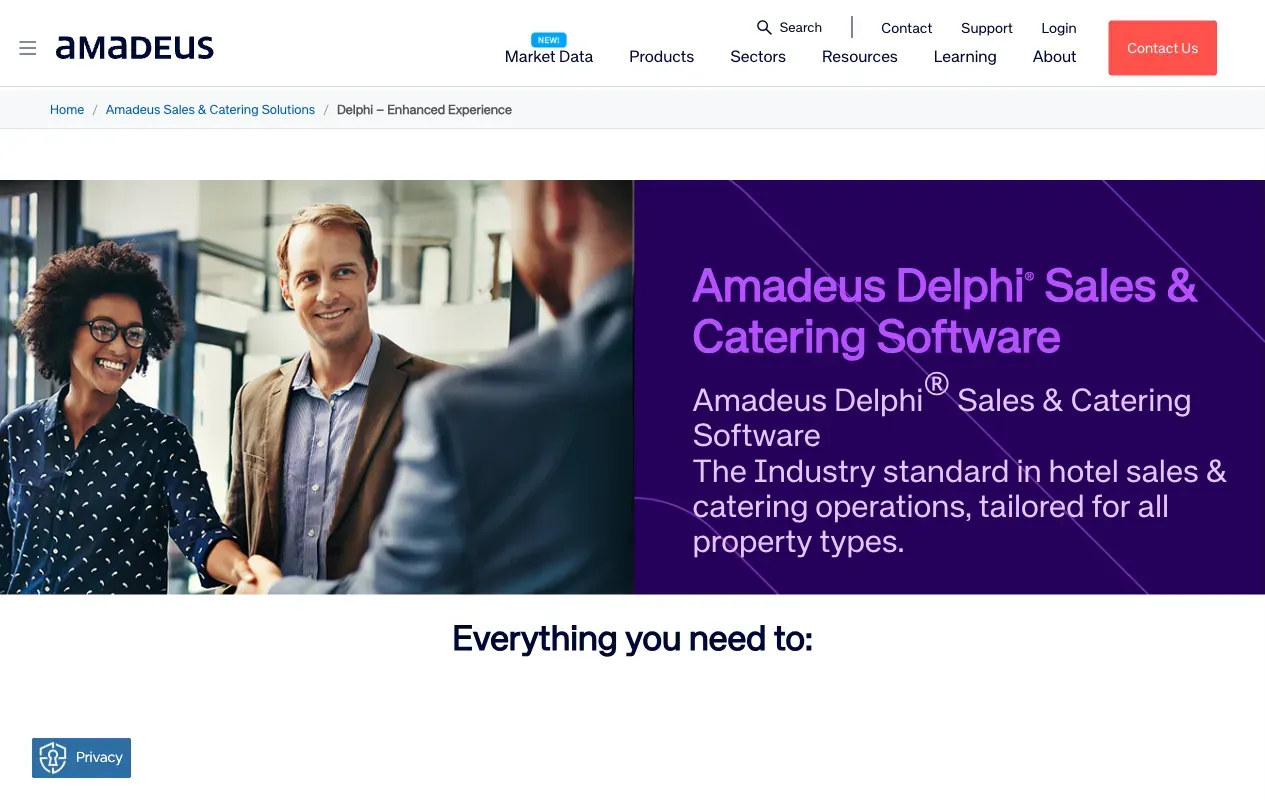
Amadeus Hospitality's M&E products descend from Newmarket International, founded in 1985 in Portsmouth, New Hampshire, and acquired by Amadeus for $500M in a deal that closed in early 2014. Delphi is its sales-and-catering system, built on the Salesforce platform and described by Amadeus as the “industry standard in hotel sales & catering operations”, with Delphi Direct and Delphi Diagramming alongside it. MeetingBroker is the intake layer: it centralises group and meeting RFPs arriving by email, referral, phone and third-party platforms into one lead-management hub and routes each lead to the right team member, with an Email to RFP capability that “uses generative AI to convert inbound group booking emails and attachments into structured RFPs”. Amadeus names Omni Hotels & Resorts, Hilton Prague and Silverstone among its customers. Both are quote-only, and both are aimed at full-service and branded hotel sales teams. Amadeus Ventures, the corporate venture arm of Amadeus, is an investor in hivr.ai.
Best for
Hotel groups already standardised on Amadeus that need a sales-and-catering system of record, and inbound RFPs structured and routed to the right salesperson. Read the full MeetingBroker head-to-head comparison.
9 of 10
Meetago – German-language corporate meeting portal
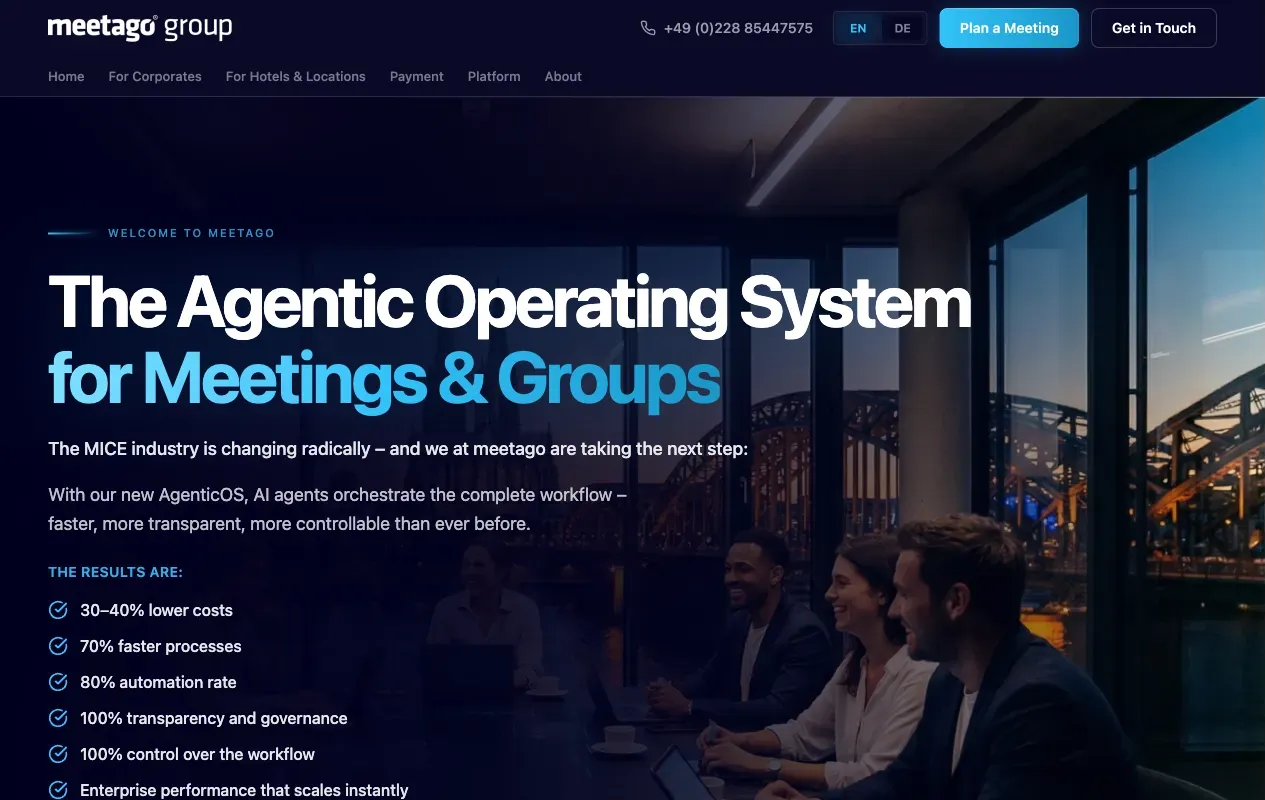
Meetago is a German-language booking portal that, by its own account, has spent around two decades connecting conference hotels and venues with corporate meeting buyers, and reports 10,000+ corporate customers including Deutsche Bahn, Bosch and Volkswagen, 100,000+ connected hotel and venue partners, and a 24% proposal-to-booking conversion rate on the RFPs it routes. It runs as a two-sided marketplace: corporates source and send meeting RFPs on one side, hotels and venues get access to that demand on the other. Its business-facing site describes the product as “The Agentic Operating System for Meetings & Groups”, though the systems it names connecting to – Concur, Cytric, Ariba, Coupa, SAP – are the buyer's, not the hotel's. For a hotel, the proposition is demand from the German corporate market, delivered as enquiries you then answer. Meetago's own hotel-facing pages point hotels at hivr.ai, through its MEETA-X connection, to answer those enquiries automatically.
Best for
Conference hotels in the German-speaking market that want access to corporate meeting demand through a booking portal, rather than a system that works the enquiries already arriving on their own channels.
10 of 10
Thynk – Salesforce-based platform for multi-property groups
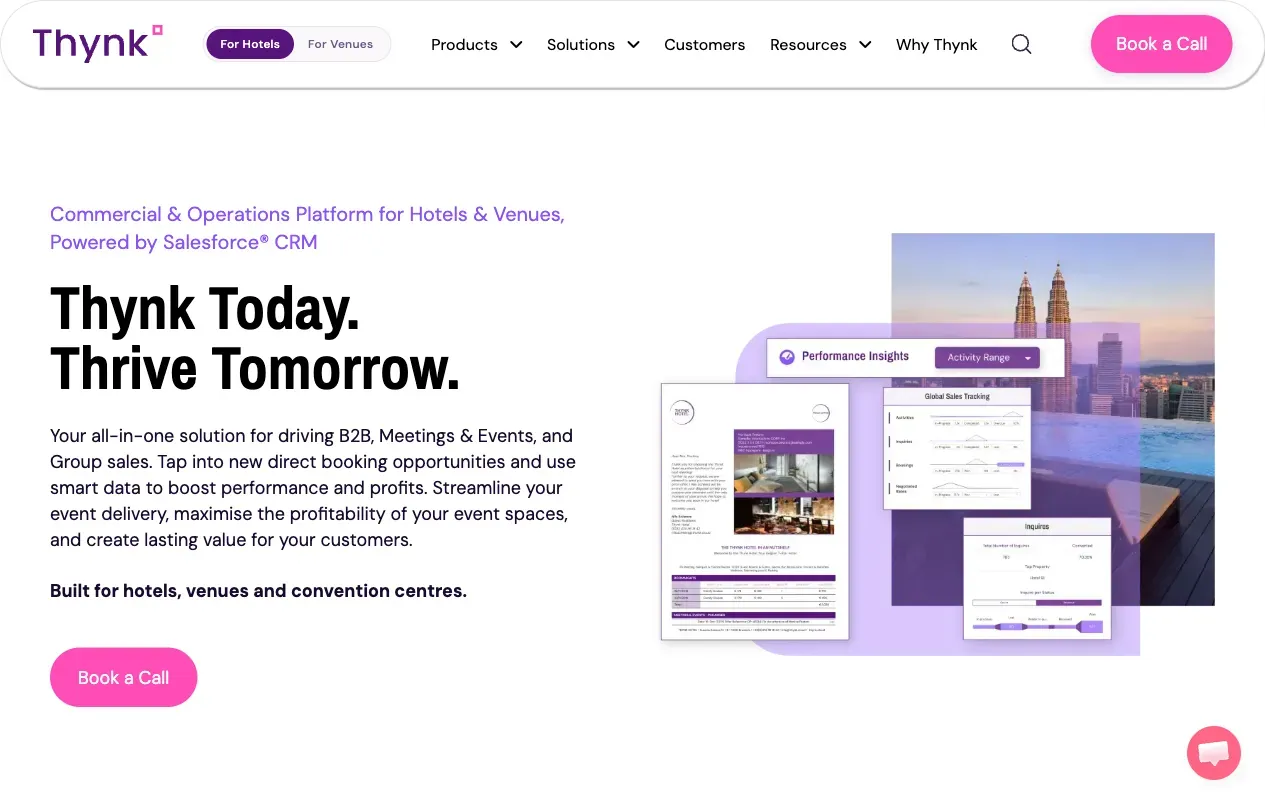
Thynk was founded in late 2019 in Belgium by a hotelier and a Salesforce consultant, and is built on the Salesforce platform. It sells a hospitality commercial platform covering CRM, sales and catering, group bookings, B2B account-based sales, inquiries and distribution, Thynk Direct as a booking engine, analytics, and Connect for integrations, and it reports 2,500+ customers across hotel groups, resorts, management companies, venues and convention centres. Its named customers include Postillion Hotels, Bilderberg Hotels and Sonesta International Hotels Corporation, and it holds 4.4 out of 5 across 120 HotelTechReport reviews. It is the entry on this list furthest from MeetingPackage's own category: a commercial platform for multi-property groups rather than a booking-and-distribution system. hivr.ai integrates with Thynk, feeding qualified, quoted enquiries into it.
Best for
Multi-property hotel groups that want their B2B, group and event commercial data in one Salesforce-based platform. Read the full Thynk head-to-head comparison.



Also worth knowing
Several categories of tool come up in this search and are deliberately not on the list. Groupize and Bizly are bought by corporate meeting departments to source and manage meetings, not by hotels to sell them, so they sit on the other side of the table. Skedda is desk and room scheduling for offices. And Cvent Passkey and VenueDirectory are both Cvent products, folded into that entry rather than counted twice. Perfect Venue, Planning Pod, Event Booking Engines and Momentus (formerly Priava) are real products in the wider venue-booking space, closer to Tripleseat's market than to MeetingPackage's. The six products hivr.ai is most often weighed against each have their own breakdown in the alternatives index.
Switching from MeetingPackage: what to check first
If you already run MeetingPackage, you're not choosing a first system, you're planning a move – and the questions that decide whether it goes well are different. Five worth answering before you shortlist anything:
- Map what is connected today. A CRS usually sits in the middle of several live connections: the booking widget on your website, the channel manager pushing space to third-party platforms, lead distribution across a portfolio, and the PMS and sales-and-catering links. Map them first. It is the fastest way to tell a genuine rip-and-replace apart from something that can run alongside what you already have.
- Check your contract term and notice period. Find your renewal date and notice window early: in this category they usually set the timeline more than the technology does, and knowing them tells you whether you're planning for next quarter or next year.
- Confirm your data comes out. Historic enquiries, accounts, rates and proposal templates are worth more than they look, because they are what a new system learns your pricing and patterns from. Ask for the export format before you sign anything, not after.
- Plan for enquiries in flight. M&E enquiries run for weeks and months, so a changeover needs a period where both systems are live. Anything you can add without a cut-over avoids this problem rather than solving it.
- Decide whether you're replacing the system or the work. This is the one most teams skip, and it is the only one that changes the outcome. Swapping one platform for another leaves the same people doing the same qualifying, pricing and chasing in a different interface. Ask of every option above: which of those tasks stops happening?
Four of those five are the cost of pulling one system out and putting another in its place. hivr.ai isn't that. It runs alongside the systems you already have, so the agents start working your enquiries while the PMS, S&C system, CRM and your existing booking and distribution setup stay exactly where they are – which is why teams are usually live in weeks rather than at their next renewal date. That leaves only the last question, which is the one worth asking anyway.
However that question lands, it is settled in one demo rather than in a feature list: take a real enquiry from last week to any vendor here and ask to watch it become a qualified, quoted proposal. hivr.ai's demo is built around exactly that.
hivr.ai as a MeetingPackage alternative
Most M&E business never fits an instant-book flow. It arrives as a negotiated conversation – dates that move, a room block, F&B, AV, a rate that has to be quoted before anyone can say yes – and the speed of the first reply decides who wins it. hivr.ai is built for exactly that workflow.
What hivr.ai does
The agents capture every enquiry from every channel, respond in minutes rather than days, carry it through proposal and binding signature, and fill the block afterwards – reading availability and rate rules out of the S&C system, PMS and CRM to build the quote, then writing the enquiry, proposal and booking back, matched to the right account. The simple end is covered as well, by the direct booking engine described above, so the negotiated enquiries are what the team actually spends its time on. The distinction that separates it from most of this list is that the work stops happening rather than moving to a better screen.
Does it work at portfolio scale, on our stack?
The two questions a multi-property group asks first. hivr.ai runs across 2,000+ hotels and venues, including portfolio rollouts – at NH Hotel Group, response times fell by more than 30%. On the stack: the agents connect to the systems of record a hotel already runs, reading meeting-room availability from the S&C system, bedroom availability from the PMS or CRS, rate rules from revenue management, and matching each enquiry to its existing CRM account, across 100+ integrations. Properties on mixed systems are the normal case, not the exception.
With hivr.ai we eliminated response timeouts entirely, and our conversion rates climbed at the same time. It's a real game-changer for our convention sales.

Questions teams ask
Is hivr.ai a MeetingPackage alternative?
Yes. hivr.ai is the AI Sales Engine for meetings, groups and events and covers everything a CRS is bought for and more: capture from every channel including the phone, qualification, quoting across space, bedrooms, F&B and AV, a live proposal with a binding signature on it, direct booking for the simple requests, and the contracted room block filled afterwards. The difference in kind is that hivr.ai's AI agents can do that work rather than presenting it to a person to do – and you decide, step by step, how much of it they own.
What is the best MeetingPackage alternative?
For taking the manual work out of meetings, groups and events, hivr.ai is the best fit: the AI agents capture every enquiry from every channel, qualify and quote it in minutes, then carry it through proposal, binding signature and a filled room block, reading availability and rate rules out of your S&C system, PMS and CRM to build the quote and writing the enquiry, proposal and booking back, matched to the right account – with your team setting how much of that runs without them. That said, it depends on the job. If you want exposure to planner demand, Cvent's supplier network is the one to look at. If you need one end-to-end venue suite covering the function diary, ticketing and payments, iVvy fits that. If you want your whole commercial team working in a single CRM, Event Temple or Thynk are built for it. And if the event itself is what you sell, Tripleseat's market is restaurants and unique venues.
Who are MeetingPackage's main competitors?
The products a hotel or venue team most often cross-shops against MeetingPackage are hivr.ai, Cvent, Tripleseat, Event Temple, iVvy, VenueSuite, MICEdesk, Amadeus (Delphi and MeetingBroker), Meetago and Thynk. They are not all the same kind of product: Cvent and Meetago are marketplaces that send you demand, VenueSuite and MeetingPackage itself are booking engines for enquiries arriving on your own channels, Event Temple, Tripleseat, Thynk and Amadeus Delphi are sales-and-catering systems your team works in, and hivr.ai and MICEdesk automate the enquiry work itself. Which ones are genuine competitors depends on which of those jobs you are buying for.
What does hivr.ai cost, and how long does it take to get live?
hivr.ai is priced on the size of your hotel or venue and scoped to your setup rather than sold in fixed tiers, so the number depends on your portfolio and enquiry volume – see what hivr.ai publishes on pricing or ask on the demo call. On timing, a simple email-to-proposal workflow can be live in just two weeks. The thing that usually sets the pace is not the software but your existing contracts and the connections into your PMS, S&C system and CRM, which is why the switching checklist above starts with your renewal date rather than with features.
Do hivr.ai's AI agents send proposals without us seeing them?
Only if you decide they should. How much runs automatically is a setting, not a fixed way of working: some teams want every proposal to pass a person before it goes out, some hand the whole workflow to the agents, and most start with one part – usually email capture and qualification – and extend it as they get comfortable. You define which steps the agents own and which stay with your team, and you can change that at any point, by season, by enquiry type or by property. Design Offices, for example, automated instant booking for short-lead single-room meetings on rules they wrote themselves, and kept complex events with their team throughout.
Which MeetingPackage alternative suits a small or independent venue?
VenueSuite publishes its pricing openly, starts at no monthly cost and is built for commission-free direct bookings from a venue's own website, which makes it the easiest to trial without a procurement process. Event Temple also publishes a starting price and is the lighter option if what you need is a sales-and-catering CRM rather than a booking engine. hivr.ai is worth looking at at any size once enquiry volume outgrows what one person can qualify and quote by hand, since the agents can do that work rather than organising it for someone else to do.
Where does hivr.ai store our data, and does it meet GDPR requirements?
hivr.ai is a European company based in Germany. All customer enquiry content is processed and stored inside the EU, and customer data is never used to train models shared across customers – each property's data stays its own. Retention specifics are covered on the demo call. That is worth putting to every AI-based option on this list, not only hivr.ai: because these systems read from and write to your PMS, sales-and-catering system and CRM, ask each vendor where the enquiry content is processed, what is retained, and whether your data is used to train shared models.
Ten alternatives, one test. Run it on a real enquiry.
Bring one from your inbox and watch it become a qualified, quoted proposal in under two minutes.